I am interested in how scientific ideas can be communicated without
losing the questions, uncertainties, and conceptual difficulties
that make them interesting. For me, science communication is not
only about simplifying technical material, but also about finding
the right way into an idea, whether through a thought experiment,
a physical object, a philosophical question, or something
unexpectedly ordinary.
Writing
Writing
Uncertain Stations
Uncertain Stations is my science communication blog, where
I write about physics, its foundations, and the philosophical
questions that emerge around them. I started it as a place to
explore scientific ideas outside the format of academic work,
while still taking the underlying concepts seriously.
I am particularly interested in communicating foundational questions
without flattening the uncertainty or disagreement around them.
The aim is not always to arrive at a neat answer, but to make the
problem itself clearer and give readers enough of the underlying
physics to understand why the question matters.
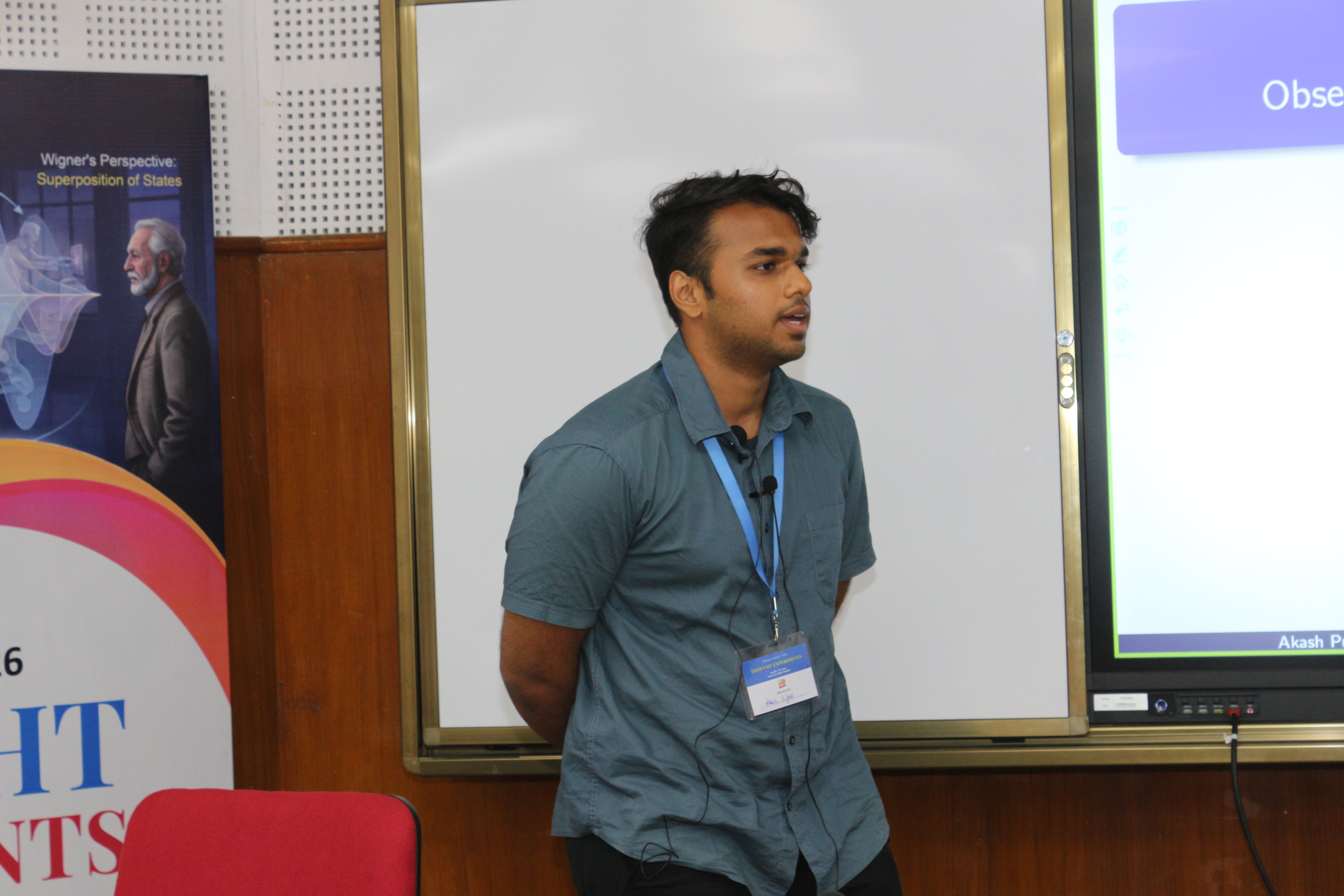
For this presentation, I explored extended Wigner's Friend scenarios, particularly the Frauchiger–Renner theorem and Local Friendliness, and the questions they raise about different observers describing the same situation. I tried to find a way of presenting these ideas that made the foundational questions accessible without losing what makes them interesting in the first place. Presenting it to an interdisciplinary audience also gave me a chance to see how people coming from different backgrounds approached and responded to the same questions.
Presentation
Origami in Science
ICTS Open Science Day
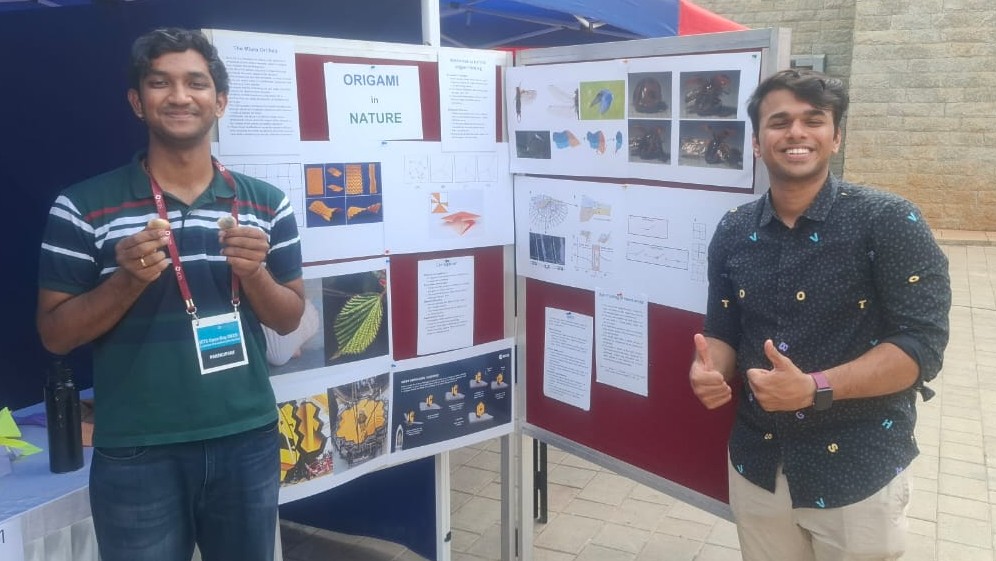
I presented a poster exploring the role of origami across
science and technology, looking at how the mathematics and
mechanics of folding appear in contexts ranging from deployable
structures to applications at very different physical scales.
The project was an opportunity to use something familiar and
tactile as an entry point into ideas across mathematics,
physics, engineering, and biology.
This is a talk exploring different ways of thinking about how scientific
knowledge develops, using Bayesian reasoning and Popper's
philosophy of falsification as two entry points into questions
about evidence, belief, and scientific progress. I was interested
in what each framework draws our attention to when we ask how
our confidence in scientific claims changes. The talk was aimed at a physics audience.
Photos
A few photos from talks and presentations along the way.
📷
Presenting on Wigner's Friend at the Thought Experiments Summer School, IIT BHU Varanasi, June 2026
📷
Origami in Science poster with Amrit, ICTS Open Science Day